
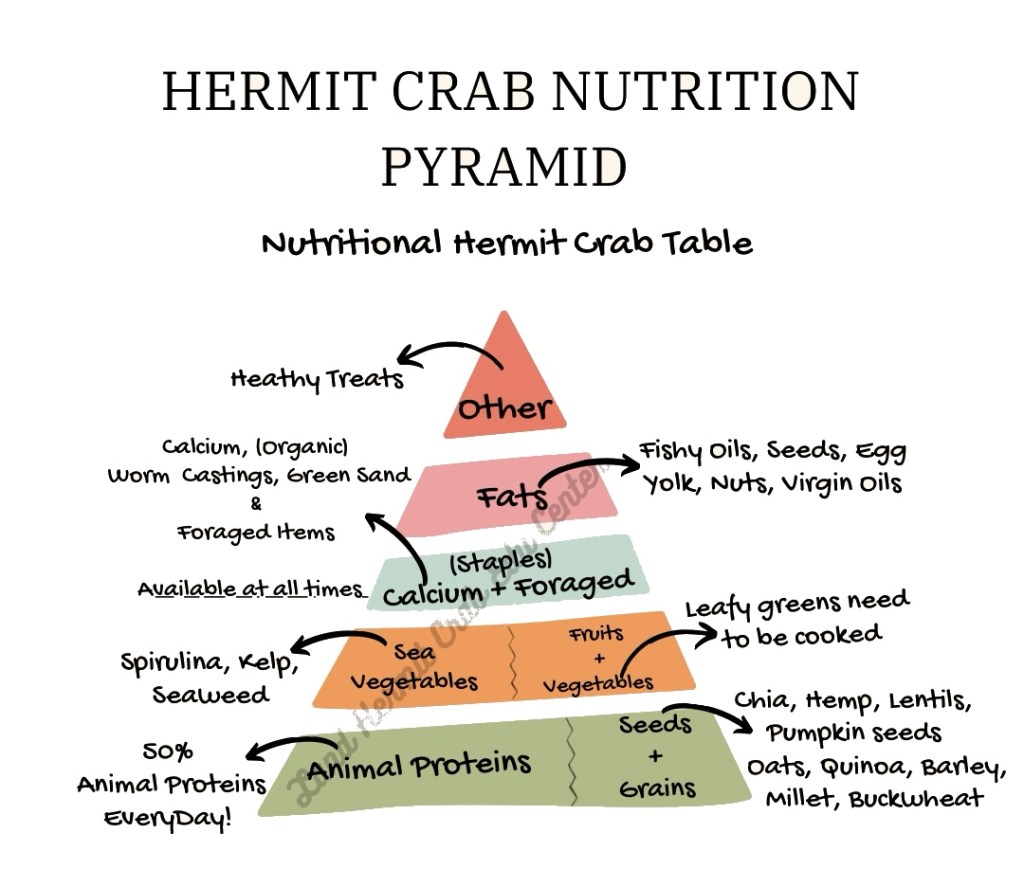
Why Nutrition Matters
Let’s Talk Hermit Crab Nutrition: What Does the Science Actually Say?
Understanding food, nutrients, and the research behind what we feed our land hermit crabs.
There is a lot of information circulating in the hermit crab community about protein, fats, oils, calcium, vitamins, and what a complete meal should contain. Some of that information has scientific research behind it, some comes from observations and experience, and some is repeated so often that people assume it must be a proven fact.
I want to talk about something that I think is really important when it comes to feeding our land hermit crabs: understanding why we offer the foods we do, instead of simply following a list of ingredients or percentages someone tells us are necessary.
But those are not all the same thing.
One thing I’ve learned while looking into crustacean nutrition is that we have to be careful about how we interpret research. Scientists have studied the nutritional needs of shrimp, marine crabs, lobsters, and crayfish for years, but there is still a lot we don’t know about the exact nutritional requirements of our terrestrial hermit crabs.
That doesn’t mean we cannot learn from those studies. It means we need to understand what the research actually shows and be honest about what has not been established yet.
First, let’s understand the evidence
Throughout these lessons, I’ll use three categories to help distinguish what we know.
- Direct research: Studies conducted on land hermit crabs themselves.
- Research: Studies of other crustaceans that give us insight into analogous biological processes.
- Still needs research: Things that may make biological sense but have not been adequately established for land hermit crabs.
I think this distinction is important because I don’t want to tell anyone that something is a definite requirement when the research hasn’t actually demonstrated that.
Our goal is to learn, ask questions, and make informed decisions about the foods we offer.
LESSON 1: Why I Think Food Variety is Important
Do you ever wonder why we can’t eat just one food or one combination of ingredients for every meal?
There’s actually some fascinating research on this!
Crabs fed the mixed diets had higher relative growth rates than those fed single food diets. The foods also differed nutritionally, flowers having more carbohydrate, snails more protein and seeds more lipids.
The study also found that the crabs tended to prefer food odors associated with foods that they had not eaten recently.
What does this mean for us?
It gives us direct experimental evidence that dietary variety can matter to at least one species of land hermit crab. It also supports the idea that offering foods with different nutritional profiles may be beneficial.
It does not prove that every feeding rotation is nutritionally complete or that every species has identical preferences. But it gives us a good reason to take variety seriously.
My takeaway of all of this: I don’t want to think of variety as simply offering different flavors. I want to think about the different nutrients that different foods can contribute.
Research & And Further Reading :
Thacker, R. W. (1998). Avoidance of recently eaten foods by land hermit crabs, Coenobita compressus. Animal Behaviour, 55, 485–496.
This study studied dietary choice and food avoidance in land hermit crabs. It’s a great helpful starting point for discussing feeding variety.
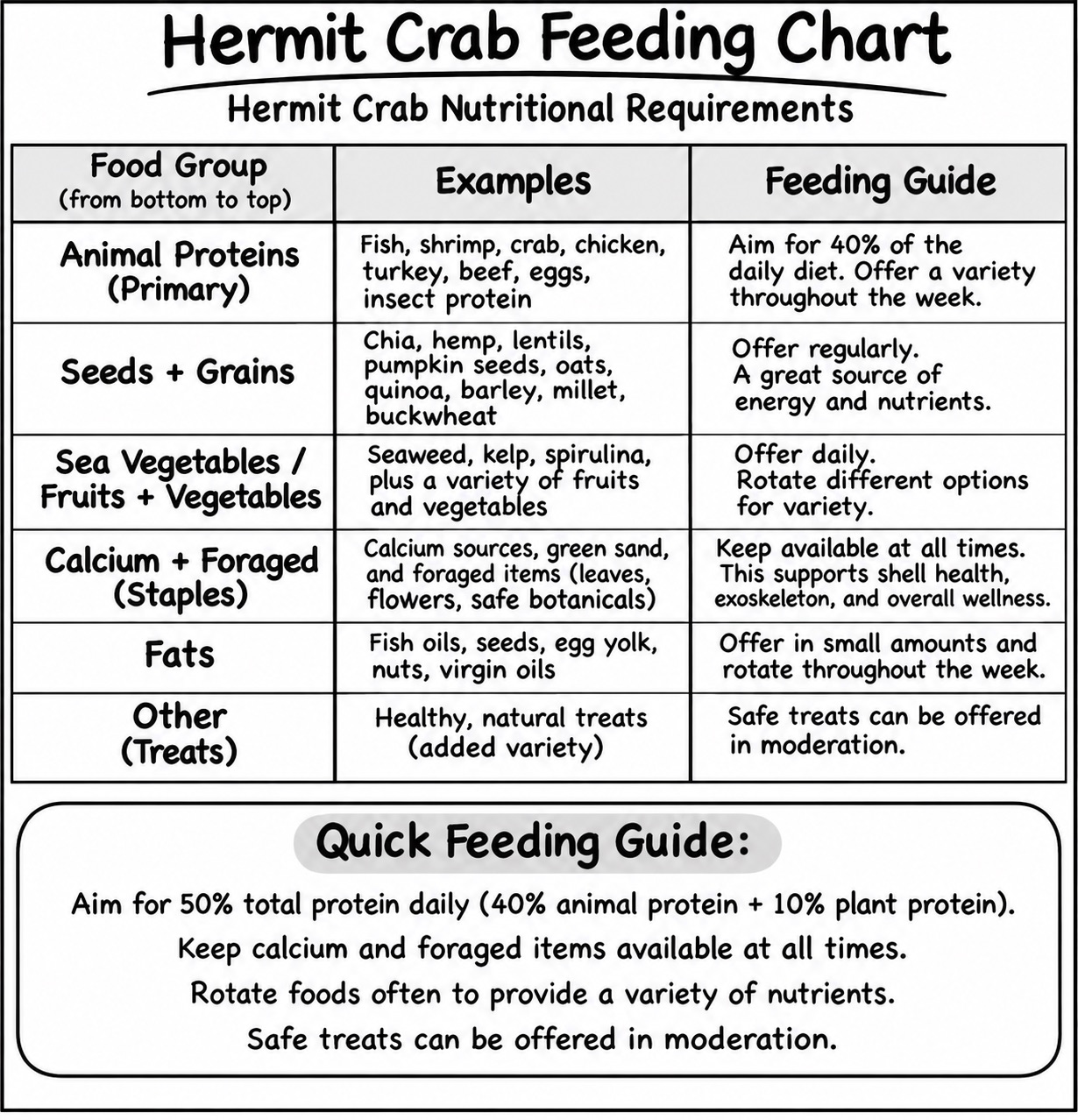
My Feeding Chart
You can also view and print my original black-and-white feeding chart below.
List Of Foods I Feed My Hermit Crabs
My hermit crab care app has a more detailed list of foods I feed, preparation notes, and other care information. You can open it right from your phone without an App Store download.

